
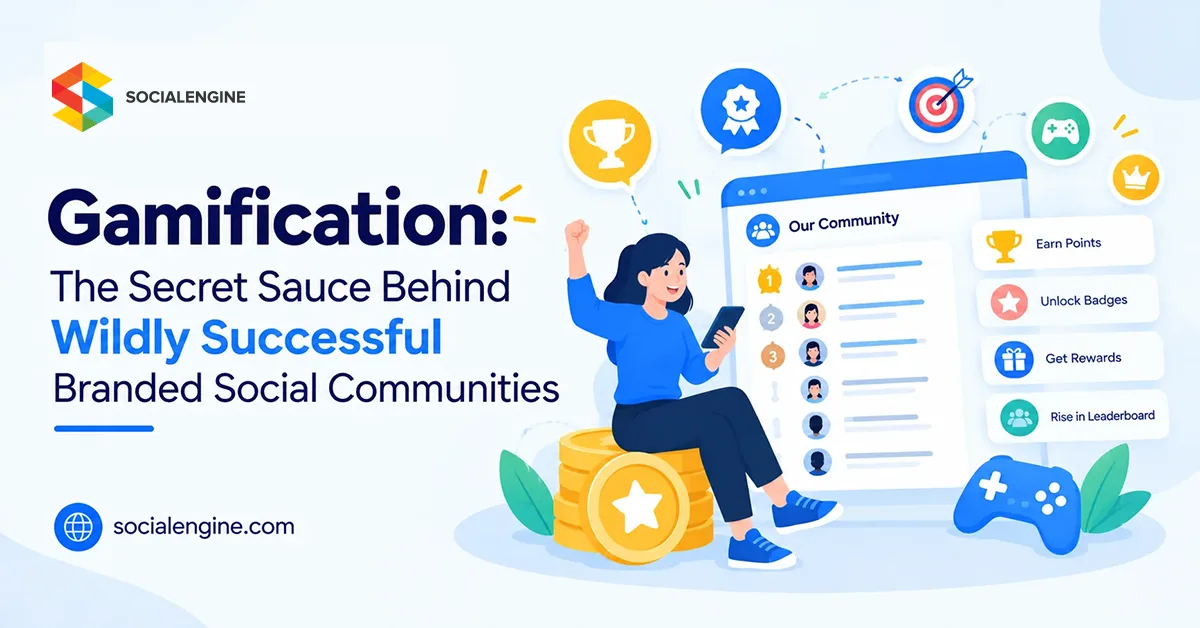
Why do some online communities feel alive while others feel like a room nobody has visited in weeks? Often, it comes down to what happens after a member joins. If people post a question and hear nothing back, they leave. If they contribute something useful and get no recognition, they may stop contributing. And if there is no clear reason to come back, the community slowly becomes a collection of inactive profiles.
Gamification can help change that. Used well, it gives members small reasons to participate and bigger reasons to keep coming back. A badge after completing a profile, recognition for helping another member, credits for useful activity, or a community challenge can turn an ordinary interaction into something people notice.
That is the important distinction: gamification is not about making your community childish or turning it into a game. It is about giving members feedback and recognition for the behaviors that make the community worth joining in the first place.
What Is Gamification in an Online Community?
In simple terms, gamification means borrowing ideas from games and applying them to a non-game experience. In a branded social community, that might include points, badges, member levels, challenges, leaderboards, progress indicators, rewards, or credits.
Imagine two new members joining the same community. One sees a blank profile and a generic welcome message. The other sees a short checklist: complete your profile, introduce yourself, join one relevant group, and answer a question. After completing those steps, the member receives a badge and unlocks a small perk. The second experience gives the member a reason to do something instead of wondering what to do next.
That is where gamification earns its place. It should make useful actions clearer and more rewarding, not manufacturing activity for the sake of activity.
Why Gamification Can Make a Community More Engaging
People generally want to know that their effort matters. In a community, that can be surprisingly easy to overlook. Someone may spend ten minutes answering another member’s question, share a useful resource, or attend an event, and the interaction disappears into the feed.
Gamification gives those actions a little more visibility.
- Recognition: A badge, title, or public acknowledgment can show that a member has contributed something useful.
- Progress: Levels and milestones give members a sense of where they are and what they can do next.
- Feedback: Points, credits, notifications, or achievement messages confirm that an action was noticed.
- Participation: Challenges and prompts can remove the “What should I do here?” feeling that new members often have.
- Community identity: Special roles or achievements can help long-term members feel that they belong to something rather than simply using another website.
7 Practical Gamification Ideas for a Branded Social Community
1. Give Members Points for Actions That Matter
Points are easy to understand, but the real work is deciding what deserves them.
For example, you could give a small number of points for completing a profile, more for publishing a useful post, and additional recognition for answering questions or helping another member. The exact numbers matter less than the logic behind them.
A common mistake is rewarding every click. If members can earn large numbers of points simply by liking posts or posting one-word comments, the system quickly becomes noisy. Reward the behaviors you actually want more of.
2. Make Badges Mean Something
Badges work best when a member can look at one and immediately understand why they earned it.
A community for professionals might use badges such as “Helpful Contributor,” “Industry Expert,” or “Community Mentor.” A creator community could recognize “First Published Resource,” “Top Contributor,” or “Workshop Host.”
Keep the number of badges manageable. Ten meaningful achievements are usually more memorable than fifty badges that nobody understands.
- Give each badge a clear requirement.
- Connect badges to useful community behavior.
- Explain how members can earn them.
- Use badges to recognize different types of contribution, not just posting frequency.
3. Use Challenges to Give Members a Reason to Act
Challenges are particularly useful when you want members to complete a series of actions.
Consider a simple “7-Day Community Starter” challenge. Day one could be completing a profile. Day two could be joining a group. Day three might ask the members to introduce themselves. Later steps could involve answering a question or attending an event.
The point is not to keep people busy for seven days. The point is to help them discover the community’s useful features while building a habit of participation.
4. Use Leaderboards Without Turning the Community Into a Competition
Leaderboards can be fun, but they are not right for every audience.
If you use one, think beyond a permanent “Top 10 Members” list. A weekly helpful-answer leaderboard or a monthly event-participation board can give members a fresh opportunity to take part. Group-specific leaderboards can also work better than one giant ranking.
Most importantly, reward quality. A member who writes two genuinely useful answers should not automatically lose to someone who posts twenty low-value comments.
5. Create Member Levels
Levels give members a longer-term target. Instead of earning one badge and stopping, members can gradually move through a series of roles.
For example: New Member → Contributor → Active Member → Community Expert → Community Leader.
Each level can unlock recognition, access, permissions, or other benefits. The progression also gives community managers a natural way to recognize members who have become valuable contributors.
6. Offer Rewards People Actually Want
A reward only works if the member cares about it. That sounds obvious, but it is easy to get wrong.
In a branded community, useful rewards might include early access to content, an invitation to a private group, a session with an expert, event access, premium resources, community credits, profile recognition, or a special member role.
Sometimes recognition itself is the reward. Being featured as a community contributor or having an expert badge beside your name can be more appealing than a small discount.
7. Build Campaigns Around a Shared Goal
Gamification becomes more interesting when the community is working toward something together.
For example, a brand could launch a month-long knowledge-sharing campaign. Members earn recognition for publishing resources, answering questions, or inviting relevant experts. When the community reaches a shared contribution target, everyone receives access to a special resource or event.
This changes the feeling from “the brand wants us to engage” to “we are building something together.” That difference matters.
Gamification Ideas by Community Goal
| Goal | Possible mechanic | Reward | What to measure |
| Improve onboarding | Starter challenge + badge | Welcome badge or access | Profile completion |
| Increase useful content | Points + contributor badge | Recognition or premium resource | Useful contributions |
| Increase event attendance | Event challenge | Event badge or credits | RSVP and attendance |
| Improve retention | Milestones + streaks | Exclusive content/access | Returning members |
| Encourage peer support | Helpful-answer points | Mentor status | Answered/accepted questions |
| Generate referrals | Referral challenge | Credits or community perks | Qualified referrals |
The Most Important Rule: Do Not Gamify Everything
This is where many community strategies go wrong.
If every login earns points, every like earns points, every comment earns points, and every action comes with a badge, the experience quickly becomes cluttered. Members stop seeing the rewards as meaningful.
Start with the community behavior you want to improve. Maybe new members are not completing their profiles. Maybe discussions receive very few answers. Maybe event attendance is weak. Pick one problem and design a small gamification experiment around it.
A focused system is easier to understand, easier to manage, and much easier to measure.
How SocialEngine Can Support Gamified Communities
We give brands control over the structure and experience of their own online community. Along with core social features such as activity feeds, posts, comments, likes, groups, messaging, notifications, and events, We include rewards and credits capabilities.
Administrators can use credits to encourage activity and create an internal reward system. Depending on the community model, credits can be connected to activities and used toward premium features or content.
- Reward members for meaningful participation.
- Connect rewards with posts, groups, events, and other community activity.
- Use member profiles, levels, permissions, and recognition to differentiate experiences.
- Combine rewards with notifications and content to bring members back.
- Extend the community with plugins as new engagement needs appear.
How to Build a Gamification Strategy That Does Not Feel Forced
Start with one problem. Decide what is not happening enough: onboarding, posting, answering, attending events, returning, or referring others.
Choose the behavior. Be specific about the action you want members to take.
Pick one mechanic. Start with a badge, challenge, points system, level, or reward rather than launching everything at once.
Decide what members get. The reward should make sense for your audience.
Explain the rules. Members should understand what they can earn and why.
Run it for a defined period. A two- or four-week experiment is easier to evaluate than an open-ended launch.
Look at behavior, not just activity. If comments doubled but useful conversations did not improve, the system needs work.
What Should You Measure?
The number of badges earned is not a business outcome. The real question is whether members are doing more of the things that make your community successful.
- Are more new members completing onboarding?
- Are members returning after their first visit?
- Are useful posts and answers increasing?
- Are event registrations turning into attendance?
- Are members completing challenges?
- Are rewards actually being redeemed?
- Are referrals bringing in relevant members?
- Is engagement contributing to subscriptions, purchases, or other revenue?
These measurements also help prevent a common problem: creating a gamification system that looks successful in an admin dashboard but does not improve the member experience.
Common Gamification Mistakes
- Rewarding activity instead of contribution.
- Making competition the only way to succeed.
- Using rewards that members do not care about.
- Making the points system complicated.
- Changing the rules without telling members.
- Encouraging spam because posts or comments earn points.
- Creating pressure that makes participation feel compulsory.
- Tracking vanity numbers instead of meaningful community outcomes.
A healthy community should still feel useful without the reward layer. Gamification should add momentum, not become the only reason people participate.
Personalize the Experience Instead of Giving Everyone the Same Challenge
A new member and a five-year community contributor should not necessarily receive the same gamification experience.
For a new member, the goal may be discovery: complete a profile, join a relevant group, and make a first contribution. For an experienced contributor, the goal could be mentoring, hosting an event, publishing expert content, or helping unanswered questions.
This is where gamification and personalization work particularly well together. The reward mechanics can remain simple while the actions change according to the member’s role and stage in the community.
For more ideas on personalization, Check out our article “5 Ways to Personalize the User Experience on Your Social Network.”
Examples of Gamification Across Different Branded Communities
Professional community
Recognize members who answer industry questions, share original research, host discussions, or mentor newer members. Expert titles and featured-contributor recognition can work better than flashy rewards.
Creator community
Use publishing milestones, content challenges, live-session achievements, and featured-creator recognition to encourage consistent creation.
Customer community
Reward customers who answer product questions, share useful solutions, attend training sessions, or provide constructive feedback. The result can be a stronger support ecosystem, not just more activity.
Membership community
Use onboarding milestones, member levels, event achievements, referral rewards, and exclusive-access rewards to reinforce the value of staying involved.
Final Takeaway
The best gamification does not feel like a points system sitting on top of your community. It feels like the community is paying attention.
A member gets recognized for helping someone. A new user knows exactly what to do after joining. A regular contributor has a clear next milestone. An event gives people a reason to participate. Those small moments can add up to a community that feels active and rewarding to be part of.
For brands building their own social community, that is the real opportunity. Use gamification to reinforce the behaviors that matter, keep the rules simple, reward quality, and give members something meaningful to work toward.
With SocialEngine, those ideas can be combined with social networking, groups, events, content, messaging, rewards, credits, and monetization to create a branded community experience that belongs to your brand, not a third-party social network.
FAQs About Gamification in Online Communities
Gamification uses game-inspired elements such as points, badges, levels, challenges, recognition, and rewards to encourage useful member behavior.
It can, especially when the mechanics are tied to a real community goal. Gamification is most effective when it makes valuable participation easier to understand and more rewarding.
Start small. A simple onboarding challenge or contribution badge is often easier to launch and evaluate than a complicated points-and-leaderboard system.
No. They can work well for audiences that enjoy friendly competition, but recognition, milestones, badges, or private achievements may be a better fit for other communities.
Consider exclusive content, event access, expert sessions, credits, private groups, profile recognition, special roles, early access, or other benefits that members genuinely value.
SocialEngine combines community features with rewards and credits capabilities, allowing brands to connect recognition and rewards with activities such as content, groups, events, and member participation.
Measure the behavior you wanted to improve such as onboarding, useful contributions, retention, event attendance, referrals, or reward redemption rather than only counting points or badges.