
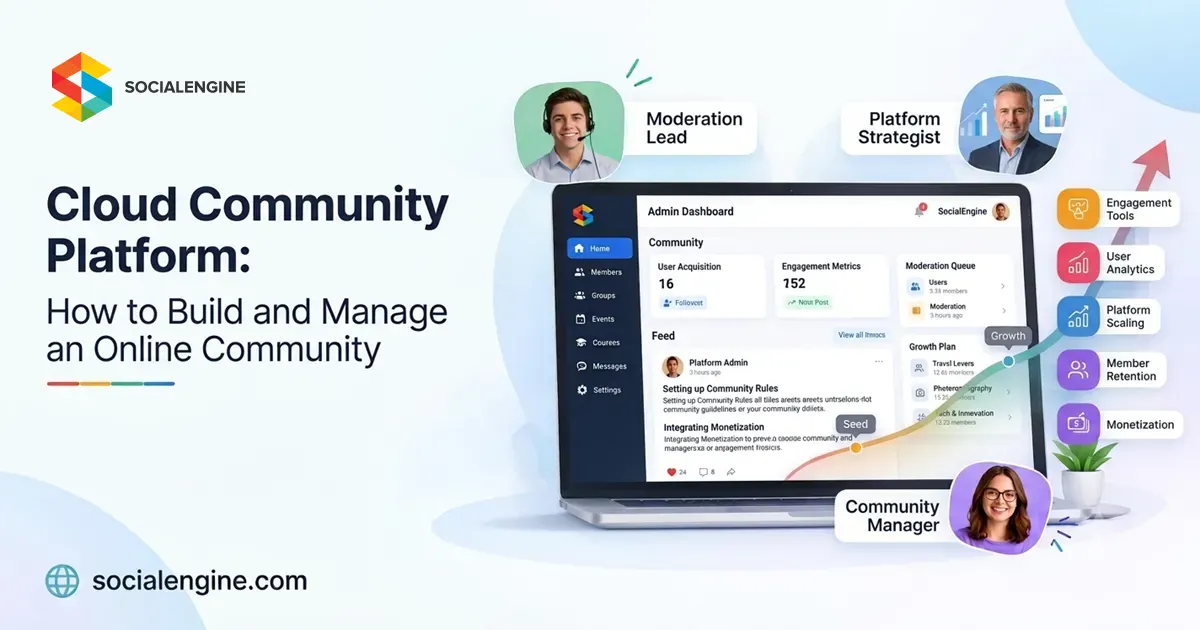
Building an online community involves more than creating a website and inviting people to join. You need reliable hosting, member management, communication tools, content features, security, updates, and a platform that can grow as your community grows.
This is where a cloud community platform can make a difference.
Instead of managing servers, software updates, infrastructure, and technical maintenance on your own, a cloud-based community platform provides the technology needed to run your community through a managed environment.
For businesses, creators, organizations, membership businesses, and entrepreneurs, a hosted community platform can provide a practical way to launch a branded online community while spending more time on members, content, engagement, and growth.
What Is a Cloud Community Platform?
A cloud community platform is software that allows you to build and operate an online community using cloud-based infrastructure.
The platform typically brings together the tools needed to manage members, publish content, create groups, facilitate discussions, send messages, organize events, and manage community activity.
Instead of purchasing and maintaining your own server environment, you use a cloud service where the infrastructure and platform operations are managed as part of the service.
An online community cloud software solution can therefore simplify the technical side of running a community while giving you a centralized platform for managing the member experience.
SocialEngine Cloud, for example, provides a cloud-based environment with community functionality, administration tools, monetization features, updates, backups, and data-center options.
Why Use a Hosted Community Platform?
Running a community yourself can involve many technical responsibilities.
You may need to think about:
- Server configuration
- Software installation
- Security updates
- Backups
- Performance
- Database management
- Platform upgrades
- Technical troubleshooting
- Scaling infrastructure
A hosted community platform moves much of this infrastructure responsibility to the platform provider.
This allows your team to focus more on the community itself.
1. Launch Without Managing Your Own Server
Cloud hosting removes the need to set up and maintain your own server environment for the community platform.
2. Simplify Platform Management
A managed environment can reduce the technical work associated with updates, infrastructure, and ongoing platform maintenance.
3. Focus on Community Growth
Instead of spending your time maintaining infrastructure, you can concentrate on attracting members, publishing content, organizing events, and improving engagement.
4. Support a Growing Community
A cloud environment can provide infrastructure designed to support communities as their requirements increase.
5. Keep Your Community Accessible
A hosted platform provides the infrastructure needed to make your community available to members without requiring you to operate the underlying hosting environment yourself.
What Features Should a Cloud Community Platform Have?
Not every hosted platform provides the same functionality. Before choosing one, consider the features your community actually needs.
Member Profiles and Connections
Members should have dedicated profiles where they can share information, connect with other members, and participate in community activities.
Activity Feeds and Content
An active community needs places where members can publish updates, share media, comment, and interact with content.
Groups and Discussions
Groups allow members with shared interests to create focused spaces for conversations and collaboration.
Messaging and Chat
Private messaging and group conversations can help members communicate directly rather than relying entirely on public discussions.
Events
Events can help communities move beyond online conversations and create opportunities for virtual or in-person participation.
Monetization
If your community is a business, the platform should support appropriate revenue models such as subscriptions, paid memberships, paid content, advertising, or other supported monetization options.
Administration and Moderation
Community owners need tools to manage members, permissions, content, settings, moderation, and day-to-day platform operations.
Mobile Access
A modern community may also need a mobile experience so members can access conversations, content, and notifications from their smartphones.
SocialEngine’s current platform combines community management, groups, events, chat, monetization, marketing, administration, extensions, and branded iOS and Android apps.
Hosted Community Platform vs. Self-Hosted Community
One of the most important decisions when building a community is how much infrastructure you want to manage yourself.
A hosted social network platform handles the hosting environment for you, while a self-hosted solution gives you greater responsibility for the server and infrastructure.
| Factor | Hosted Community Platform | Self-Hosted Platform |
| Hosting | Managed by the platform provider | Managed by you or your technical team |
| Server Setup | Generally handled as part of the service | You need to configure your own infrastructure |
| Updates | Provider-managed depending on the service | You are responsible for updates |
| Backups | May be included by the provider | You need to establish your own backup strategy |
| Maintenance | Less infrastructure maintenance for your team | Greater technical responsibility |
| Customization | Depends on the cloud plan and platform | Generally provides more direct control |
| Scaling | Infrastructure is managed through the hosting environment | Your team manages infrastructure scaling |
| Technical Resources | Lower infrastructure burden | Requires greater technical involvement |
The right approach depends on your technical resources, customization requirements, infrastructure preferences, and long-term community plans.
SocialEngine currently offers both cloud and self-hosted options, allowing customers to choose between a managed cloud environment and hosting the community on their own server.
What Is Social Network Hosting?
Social network hosting refers to the infrastructure and services used to run a social networking website or online community.
A social network requires more than basic web hosting because the platform may need to handle:
- Member accounts
- Profiles
- Social connections
- Activity feeds
- User-generated content
- Images and videos
- Messaging
- Groups
- Events
- Notifications
- Databases
- Administrative tools
Choosing the right hosting approach can therefore affect how much technical responsibility your team has.
With cloud-based social network hosting, infrastructure is provided as part of the hosted platform, allowing you to focus on managing your community rather than operating the underlying server environment.
What Is a Social Network Cloud Platform?
A social network cloud platform combines social networking software with cloud-based hosting infrastructure.
Instead of installing social network software on your own server, you access a managed environment where the platform and infrastructure are provided together.
This approach can be useful for organizations that want to launch a social network without building an entire hosting architecture themselves.
A social network cloud platform can provide a foundation for:
- Private social networks
- Membership communities
- Professional networks
- Customer communities
- Creator communities
- Business communities
- Niche social networks
- Organization communities
The exact features and infrastructure depend on the platform and plan you select.
Why Choose a Managed Community Platform?
A managed community platform can reduce the amount of technical infrastructure work your team needs to handle.
Instead of treating hosting, software maintenance, and community management as separate responsibilities, a managed solution can bring much of the technical environment together.
Managed Updates
Platform updates can be handled by the provider, depending on the service and plan.
Data Protection
A managed cloud service may include backup and infrastructure protection as part of the platform.
SocialEngine Cloud currently advertises off-site backups and automated updates as part of its cloud offering.
Data Center Options
For communities serving audiences in different regions, infrastructure location can also matter.
SocialEngine Cloud currently lists data-center locations across the US, Europe, Canada, Asia, and Australia.
Less Infrastructure Management
Your team can spend less time configuring and maintaining servers and more time managing your community.
How a Cloud Community Platform Can Help Your Business
A community can become an important part of a broader digital business.
For example, a company could build a customer community where members access discussions, resources, events, and support.
A creator could build a membership community around exclusive content and conversations.
An organization could create a private community for members or participants.
A professional organization could build a network where members connect, share knowledge, and participate in events.
The technology behind each community may be different, but the underlying goal is similar: create a dedicated environment where people have a reason to return and participate.
How to Choose the Best Hosted Community Platform for Your Needs
Rather than choosing a platform based only on its feature list, evaluate it against your actual community requirements.
1. Define Your Community Model
First determine what you are building.
Is it a:
- Membership community?
- Customer community?
- Creator community?
- Professional network?
- Private community?
- Business network?
- Niche social network?
Your community model will determine the features and structure you need.
2. Review Hosting and Infrastructure
Understand what the provider manages and what remains your responsibility.
Look at:
- Hosting
- Backups
- Updates
- Security
- Data centers
- Storage
- Traffic
- Scaling
3. Evaluate Customization
Your community should reflect your brand rather than look like a generic template.
Review available options for branding, layouts, member experiences, plugins, integrations, and custom development.
4. Consider Monetization
If your community is intended to generate revenue, check whether the platform supports your business model.
Potential models include:
- Memberships
- Subscriptions
- Paid content
- Advertising
- Marketplace transactions
- Courses
- Events
- Credits and rewards
5. Look at Mobile Support
Members increasingly access digital communities from smartphones.
Consider whether the platform supports responsive web experiences or branded iOS and Android apps.
6. Check Future Expansion
Your community may start with a few hundred members but eventually require additional features.
Look for a platform that can support additional applications, plugins, integrations, AI capabilities, and other functionality as your needs evolve.
Cloud Community Platform vs. Traditional Web Hosting
Traditional web hosting gives you server space for websites and applications.
A cloud community platform goes further by combining hosting infrastructure with community software and management capabilities.
| Traditional Web Hosting | Cloud Community Platform |
| Provides hosting infrastructure | Provides hosting plus community software |
| You may need to install applications | Community functionality is provided by the platform |
| Greater technical responsibility may be required | More infrastructure is managed for you |
| Community features need to be developed or installed | Community features are part of the platform |
| Separate tools may be required | Multiple community functions can be managed together |
For someone simply hosting a website, traditional hosting may be sufficient.
For someone building an active online community, a platform designed specifically for community management can provide a more integrated starting point.
Build Your Community With SocialEngine Cloud
SocialEngine Cloud provides a managed environment for building and operating an online community without requiring you to manage your own server infrastructure.
The platform includes community functionality, administration tools, monetization capabilities, updates, backups, and cloud infrastructure options. SocialEngine also states that cloud plans include members, website editing, admin control, email broadcasts, paid subscriptions, advertising and monetization, and custom activity feeds.
You can use it to build communities around your own:
- Brand
- Members
- Content
- Business model
- Community structure
- Engagement strategy
And as your community evolves, you can extend the platform with additional official plugins and supported functionality.
Build, Manage & Grow Your Community in the Cloud
A cloud-based approach can remove much of the infrastructure complexity involved in running an online community.
Instead of starting with servers, databases, updates, and maintenance, you can start with the community itself.
- Define your audience.
- Build your community structure.
- Customize your brand.
- Invite your members.
- Publish valuable content.
- Create conversations.
- Launch events.
- Enable monetization.
Then continue improving the experience as your community grows.
For businesses and organizations looking for a cloud community platform, the goal is not simply to put a social network online. It is to create a reliable digital environment that your organization can use to build relationships over time.
Final Thoughts
The right platform can make the difference between simply hosting a community website and building a community experience that people want to return to.
A hosted community platform can reduce infrastructure responsibilities, while an online community cloud software solution can bring community features and hosting together.
For organizations looking for a hosted social network platform, the key considerations should include customization, community features, hosting management, security, scalability, monetization, mobile access, and long-term flexibility.
If you want less responsibility for infrastructure, social network hosting through a managed cloud environment can provide a practical starting point.
And if you need a platform that combines community functionality with managed infrastructure, SocialEngine Cloud provides an option designed specifically for building and operating online communities.
Build Your Community in the Cloud
Create a branded online community with the tools to connect members, manage content, grow engagement, and monetize your audience.