
Introduction
Choosing a membership community platform is not only a question of features. It is also a question of where the platform runs, who manages the infrastructure, how much control you need, and how much technical responsibility your team is prepared to take on.
For many community owners, the decision comes down to two models: a hosted platform, usually delivered as SaaS, or a self-hosted platform installed on infrastructure you control.
Neither model is automatically right for every community.
A hosted approach can reduce infrastructure work and make launching simpler. A self-hosted approach can provide deeper control over hosting, source code, customization, branding, and data.
SocialEngine supports both approaches, giving membership community owners a choice between SocialEngine Cloud and SocialEngine Self-Hosted.
What Is a Hosted Membership Community Platform?
A hosted membership community platform is managed by the platform provider.
Instead of configuring and maintaining your own server environment, you subscribe to a service and operate your community through the provider’s infrastructure.
The provider typically handles much of the hosting environment, platform updates, backups, security infrastructure, and technical operations. The exact responsibilities vary by vendor and plan.
This model is often attractive to community owners who want to spend more time on members, content, engagement, marketing, and growth rather than server administration.
SocialEngine Cloud follows this managed approach. Its current Cloud offering includes hosting infrastructure, updates, support, backups, SSL, CDN capabilities, community features, plugins, and other platform services.
What Is a Self-Hosted Membership Community Platform?
A self-hosted membership community platform is installed and operated on your own server or hosting environment.
You have greater control over the infrastructure and software environment. Depending on the platform and license, you may also have direct source-code access, allowing deeper customization.
The trade-off is responsibility.
Your team or technical partner needs to manage hosting, backups, updates, security, performance, and other infrastructure tasks according to your setup.
SocialEngine Self-Hosted provides access to the platform’s unencrypted source code and is designed for organizations that want to host their community on their own server and customize the platform around their requirements.
Hosted vs. Self-Hosted: Quick Comparison
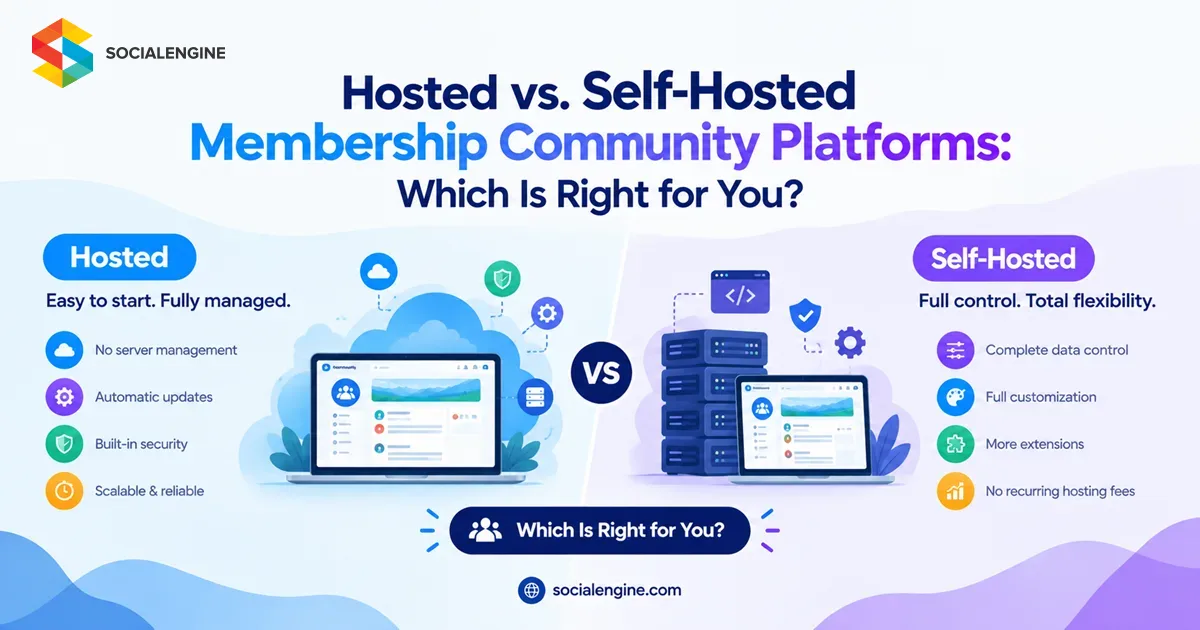
The practical difference is straightforward: hosted means the provider manages the environment; self-hosted means you manage or control the environment.
| Factor | Hosted Community Platform | Self-Hosted Community Platform |
| Hosting | Managed by provider | Managed by you or your technical team |
| Server setup | Generally handled by provider | Configured by your team |
| Updates | Provider-managed according to service terms | Your responsibility |
| Backups | May be included | You establish the strategy |
| Customization | Depends on platform and plan | Greater infrastructure/source-code control |
| Technical responsibility | Lower | Higher |
| Infrastructure control | Provider environment | Your environment |
| Source-code access | Depends on plan | Available with SocialEngine Self-Hosted |
| Branding | Depends on plan | Extensive customization |
| Maintenance | Lower infrastructure burden | Greater technical responsibility |
SocialEngine itself describes Cloud as the option for customers who do not want to set up their own server and Self-Hosted as the option for customers who prefer to host their community on their own server.
Hosted Membership Community Platforms: When Do They Make Sense?
A hosted membership community platform can be practical when your priority is reducing infrastructure work.
It can make sense if you:
- Want to launch without setting up your own server
- Have limited technical resources
- Prefer managed updates and infrastructure
- Want your team focused on members and content
- Need a simpler operational setup
- Prefer a recurring service model
For example, a creator launching a paid membership community may not want to spend time configuring servers, monitoring infrastructure, or planning software updates.
A hosted solution allows that creator to focus more heavily on building the actual membership experience.
SocialEngine Cloud is designed for customers who do not want to manage their own server. Current plans include community features, official plugins, iOS and Android mobile apps, updates, support, administration, paid subscriptions, advertising, and monetization.
Self-Hosted Membership Community Platforms: When Do They Make Sense?
Self-hosting becomes more relevant when control is an important part of your business model.
It can make sense if you:
- Need deeper customization
- Want direct source-code access
- Prefer to control your hosting environment
- Have technical resources available
- Need specific integrations
- Have infrastructure requirements
- Want greater control over your digital environment
- Are building a long-term white-label community
SocialEngine Self-Hosted is positioned around source-code access, customization, branding, infrastructure control, plugins, themes, integrations, and community management.
Cost: Look Beyond the Monthly Subscription
Cost comparisons can be misleading when you compare only the software license or monthly subscription.
For a hosted membership community platform, consider:
- Subscription fees
- Plan upgrades
- Add-ons
- Custom development
- Integrations
- Payment-related costs
- Additional services
For a self-hosted membership platform, consider:
- Software license
- Hosting
- Domain and infrastructure services
- Development
- Maintenance
- Backups
- Security
- Updates
- Technical support
The more useful calculation is:
Total community technology cost = platform + infrastructure + development + integrations + maintenance + support
Customization and White-Label Control
Customization is one of the biggest differences between deployment models.
A hosted platform can provide branding and configuration options, but the depth of customization depends on the provider and plan.
A self-hosted membership community can provide more direct control over the software environment.
With source-code access, developers can make deeper changes to layouts, workflows, integrations, backend logic, and other parts of the platform where supported.
This matters for organizations building a white-label community platform.
Your community may need to look and behave like part of your own digital ecosystem rather than a standard SaaS product.
SocialEngine Self-Hosted specifically promotes an unbranded environment, source-code access, and extensive customization.
Data, Infrastructure, and Ownership
Your deployment model also affects how you manage community data and infrastructure.
With a hosted service, your community operates inside the provider’s environment and is subject to that service’s terms, infrastructure, export options, and operational policies.
With self-hosting, the infrastructure is under your control.
SocialEngine’s current self-hosted materials state that customers own their content, user data, and proprietary code.
However, greater control also creates greater responsibility.
A self-hosted membership community needs a serious strategy for:
- Backups
- Security
- Monitoring
- Disaster recovery
- Server performance
- Software updates
Self-hosting should therefore be viewed as control plus responsibility, not simply as another hosting option.
Maintenance: The Part People Often Underestimate
Self-hosting gives you more control, but control does not mean zero maintenance.
A self-hosted community may require attention to:
- Server performance
- Security patches
- Software updates
- Backups
- Database health
- Email delivery
- SSL certificates
- Monitoring
- Disaster recovery
- Third-party integrations
Hosted platforms reduce much of this infrastructure burden because the provider manages the hosting environment and platform operations.
SocialEngine Cloud states that updates and support are included under its service terms, while customized or third-party configurations can have specialized support and upgrade conditions.
Membership Features Matter More Than Deployment Alone
Choosing hosted or self-hosted should not distract you from the actual membership experience.
Your platform should support the way members participate and the way your organization earns revenue.
Depending on your community model, you may need:
- Member profiles and directories
- Membership levels
- Paid subscriptions
- Private groups
- Discussions
- Activity feeds
- Messaging
- Events
- Courses
- Paid content
- Advertising
- Marketplace functionality
- Notifications
- Moderation
- Mobile apps
- Analytics
- Integrations
SocialEngine combines these broader community capabilities with both Cloud and Self-Hosted deployment options. Its current platform includes memberships, subscriptions, groups, discussions, messaging, events, courses, content, monetization, mobile apps, plugins, APIs, and administration.
Hosted vs. Self-Hosted for Different Community Models
The right deployment model can also depend on the type of membership community you’re building.
Creator Community
A creator may prefer hosted infrastructure when the priority is launching quickly and spending less time on server administration.
Professional Community
A professional network may place greater importance on customization, member structures, integrations, permissions, and long-term control.
Customer Community
A customer community may work with either model depending on its integration requirements and technical resources.
Private Membership Community
Private organizations may place greater emphasis on infrastructure control, permissions, privacy, and governance.
Enterprise Community
Enterprise communities often have more complex requirements around infrastructure, integrations, security, and administration.
Niche Community
A niche community may begin with a simpler hosted setup and later require deeper customization as its audience and business model develop.
The important point is that deployment should follow your requirements, rather than choosing hosted or self-hosted simply because one model is generally more popular.
SocialEngine Cloud vs. SocialEngine Self-Hosted
SocialEngine gives community owners both deployment paths.
SocialEngine Cloud
SocialEngine Cloud is the managed option.
The current Cloud offering includes:
- Community features
- Official plugins
- iOS and Android mobile apps
- SocialEngine updates
- Support
- Hosting infrastructure
- SSL
- CDN
- Off-site backups
- Email infrastructure
- Paid subscriptions
- Advertising and monetization
Different plans provide different infrastructure resources and customization capabilities.
SocialEngine Self-Hosted
SocialEngine Self-Hosted is the control-oriented option.
Current published plans provide access to SocialEngine’s unencrypted source code, while higher plans add more official plugins and mobile/source-code capabilities. SocialEngine’s FAQ also states that the Self-Hosted license is a one-time purchase and provides the complete unencrypted source code for use on one domain.
This model is designed for organizations that want greater control over:
- Hosting
- Source code
- Branding
- Customization
- Plugins
- Integrations
- Community administration
How to Decide Which Model Fits Your Membership Community
Before choosing a platform, ask yourself five questions:
1. How much technical responsibility can your team handle?
If your team has limited technical resources, managed hosting may simplify operations.
2. How deeply do you need to customize the platform?
If your requirements go beyond standard configuration, self-hosting can provide more flexibility.
3. Do you need direct control over your hosting environment?
If infrastructure control is important, self-hosting may better fit your requirements.
4. Is your community a long-term digital asset?
If your membership community is becoming a core part of your business, you may place greater value on customization, data, and infrastructure control.
5. What matters more right now: convenience or control?
This is often the simplest way to frame the decision.
A Practical Decision Framework
A hosted approach may fit if you:
- Want to launch quickly
- Do not want to manage servers
- Have limited technical resources
- Prefer managed infrastructure
- Want your team focused on community growth
A self-hosted approach may fit if you:
- Need deeper customization
- Want source-code access
- Want greater infrastructure control
- Have technical resources
- Need custom integrations
- Want greater control over your white-label environment
Your requirements can also change.
A community that begins as a small project may eventually need more infrastructure control, while an organization with a large technical team may prefer managed hosting to reduce operational overhead.
Why SocialEngine Fits Both Models
One useful aspect of SocialEngine is that you do not have to choose between a managed cloud product and an unrelated self-hosted system.
Both deployment models are part of the SocialEngine ecosystem.
With Cloud, SocialEngine handles the hosting environment and provides managed platform services.
With Self-Hosted, organizations can take greater control over hosting, source code, customization, branding, plugins, integrations, and administration.
That gives community owners a way to align their deployment model with their technical requirements and long-term plans.
Conclusion
Hosted and self-hosted membership community platforms solve the same broad problem in different ways.
Hosted platforms reduce infrastructure responsibility and can make it easier to focus on launching and operating your community.
Self-hosted platforms put more responsibility on your team, but they can provide greater control over hosting, source code, customization, branding, and infrastructure.
The right choice depends on your:
- Technical resources
- Customization requirements
- Infrastructure preferences
- Budget structure
- Data requirements
- Long-term community plans
For community owners who want both choices, SocialEngine provides a managed Cloud option and a Self-Hosted option, allowing you to select the deployment model that matches how you want to build and manage your membership community.
Frequently Asked Questions
Generally, yes. Hosted community platforms are commonly delivered as software-as-a-service, where the provider operates the infrastructure and customers subscribe to the service.
The main advantage is greater control over the hosting environment and, where the software license permits it, deeper access to source code and customization.
No. Self-hosting transfers more infrastructure responsibility to you or your technical team.
Yes. SocialEngine offers SocialEngine Cloud and SocialEngine Self-Hosted.
Yes. SocialEngine supports paid subscriptions, memberships, advertising, and other monetization functionality depending on your configuration.
Yes. SocialEngine’s current Cloud and Self-Hosted offerings include iOS and Android app options, with exact capabilities depending on the selected plan.
SocialEngine positions its Self-Hosted product as an unbranded platform that can be customized around your own brand and requirements.