
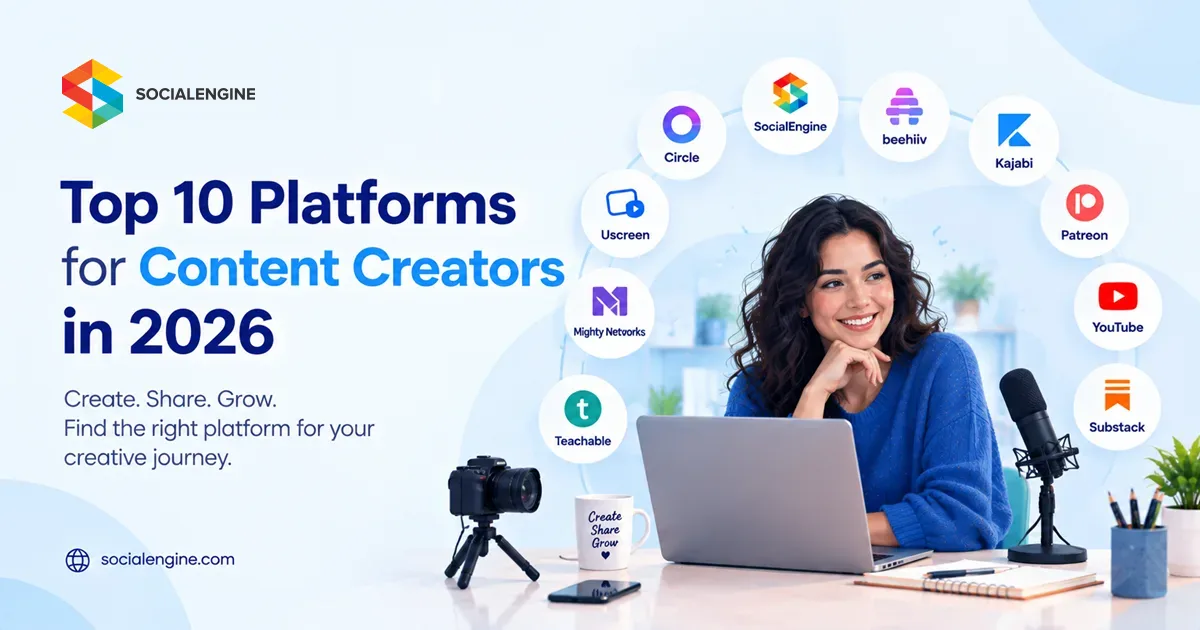
Choosing a creator platform in 2026 is less about finding the platform with the longest feature list and more about deciding what kind of creator business you want to build.
A writer may need publishing and email. A video creator may care about discovery, memberships and a premium viewing experience. A coach may need courses and payments. But a creator building a real member community needs something different: a branded place where conversations, content, events, relationships and revenue can live together.
That distinction matters.
Current creator-platform guides increasingly separate discovery, publishing, monetization and community rather than treating every platform as interchangeable. Circle, for example, organizes creator platforms around stages such as audience growth, monetization and scaling. Beehiiv puts considerable emphasis on owning the subscriber relationship, while Uscreen focuses heavily on recurring revenue through video memberships.
Quick Answer: What Are the Best Platforms for Content Creators in 2026?
For creators who want to build a branded community rather than depend entirely on a social feed, SocialEngine is a strong all-in-one option.
Here is how the major platforms compare:
| Platform | Best For |
| SocialEngine | Branded creator communities |
| Circle | Community-led creators |
| beehiiv | Newsletter and media creators |
| Kajabi | Courses, coaching and digital products |
| Patreon | Fan memberships |
| YouTube | Video discovery and monetization |
| Substack | Writers and newsletter publishers |
| Uscreen | Video memberships |
| Mighty Networks | Community and membership businesses |
| Teachable | Course creators |
The important point is that there isn’t one universally best creator platform. The right choice depends on your content format, business model, monetization strategy and how much control you want over your audience experience.
1. SocialEngine – Best for Branded Creator Communities
SocialEngine is particularly interesting for creators who have moved beyond simply collecting followers and want to build a community around their brand.
Instead of treating community as an add-on to content, SocialEngine lets the creator make the community itself part of the product.
You can build an environment where members have profiles, publish posts, comment, interact, join groups, attend events and communicate with one another.
What stands out
- Member profiles and personalized experiences
- Activity feeds
- Posts, comments, likes and sharing
- Groups and events
- Messaging and notifications
- Member levels and permissions
- Privacy and moderation controls
- Branding and design flexibility
- Monetization opportunities
- Cloud and self-hosted approaches
SocialEngine’s current feature set includes member management, profiles, activity feeds, posts, comments, likes, sharing, groups, messaging, notifications, permissions and moderation.
Why creators should consider it
Imagine you’re a fitness creator.
You could post workouts on YouTube and Instagram and hope followers keep coming back.
Or you could build a branded fitness community where members can:
- Follow workout content
- Discuss progress
- Join challenges
- Participate in groups
- Attend events
- Interact with coaches
- Share their own experiences
- Access premium experiences
That changes the relationship from creator → follower to creator → community → member.
Potential limitation
A fully branded community requires more planning than simply creating a social profile or newsletter. You need to think about member journeys, structure, moderation and monetization.
Verdict
If your long-term goal is:
“I want my audience to have a home that belongs to my brand.”
SocialEngine deserves to be near the top of your shortlist.
2. Circle – Best for Community-Led Creators
Circle is designed around community, content, events and memberships.
It makes sense for creators who want community to be central to their business rather than sending followers to a separate discussion platform.
Circle’s 2026 creator guide positions it as a platform that can help creators move from audience growth toward monetization and scaling, particularly around community, courses and events.
What stands out
- Community spaces
- Discussions
- Events
- Courses and learning content
- Membership workflows
- Creator-business features
Potential limitation
Creators who require extensive control over branding, infrastructure, integrations or ownership should compare Circle carefully against other community-first platforms.
Verdict
Circle is a strong hosted option for creators who want community to be part of the core business model.
3. Beehiiv – Best for Newsletter and Media Creators
If your creator business starts with an email list, Beehiiv deserves serious consideration.
Its 2026 positioning focuses on publishing, audience growth, monetization and subscriber ownership. It supports paid subscriptions and other monetization mechanisms while providing publishing and growth infrastructure.
What stands out
- Newsletter publishing
- Website tools
- Paid subscriptions
- Audience-growth features
- Referral and recommendation mechanisms
- Monetization options
- Subscriber ownership
Where it works best
Think:
- Independent journalists
- Newsletter writers
- Industry analysts
- Business commentators
- Niche media creators
- Personal brands built around email
Potential limitation
Beehiiv is fundamentally newsletter-first.
If your business depends heavily on groups, events, member profiles and member-to-member interaction, you’ll likely need a more community-oriented platform.
Verdict
One of the strongest choices when the creator business begins with the inbox.
4. Kajabi – Best for Courses, Coaching and Digital Products
Kajabi is built around turning knowledge into a business.
It is particularly suitable for:
- Coaches
- Educators
- Consultants
- Course creators
- Experts
- Digital-product businesses
The platform combines educational content with memberships and marketing/sales functionality.
What stands out
- Online courses
- Memberships
- Digital products
- Marketing tools
- Sales funnels
- Knowledge-based businesses
Potential limitation
Kajabi can be more than a publishing-focused creator needs, particularly when the main business is editorial content rather than courses or digital products.
Verdict
If your primary product is your knowledge, Kajabi is one of the strongest options to investigate.
5. Patreon – Best for Fan Memberships
Patreon approaches the creator economy from a different angle.
The central idea is simple: turn audience support into recurring membership revenue.
This works especially well for creators who already have loyal fans and want to provide:
- Bonus content
- Exclusive posts
- Member-only experiences
- Early access
- Community benefits
- Recurring supporter memberships
What stands out
- Recurring memberships
- Supporter-focused content
- Paid fan relationships
- Simple membership model
Potential limitation
If you’re looking for a deeply branded social network with extensive member management and community architecture, Patreon may not provide the same level of control as a dedicated community platform.
Verdict
A practical choice when fan support and recurring memberships are the primary business model.
6. YouTube – Best for Video Discovery
YouTube remains extremely difficult to ignore for video creators.
Its biggest advantage isn’t necessarily community ownership. It’s a discovery.
Creators can build audiences through:
- Long-form videos
- Shorts
- Search
- Recommendations
- Subscriptions
- Live content
YouTube is therefore particularly useful at the top of the creator funnel.
The catch
YouTube is not the same thing as owning a branded community.
Your audience is still interacting within YouTube’s ecosystem, and discovery and distribution are influenced by the platform.
That’s why many creators benefit from thinking of YouTube as:
Discovery → Audience acquisition
rather than:
Entire creator business
Verdict
Excellent for video discovery and distribution.
For creators building a long-term community business, it can work even better when paired with an owned community or audience hub.
7. Substack – Best for Writers and Newsletter Publishers
Substack has become a popular starting point for independent writers who want to publish directly to subscribers and eventually introduce paid subscriptions.
Its appeal is partly its simplicity.
You don’t need to build a complicated publishing system before writing your first article.
What stands out
- Simple publishing
- Email newsletters
- Paid subscriptions
- Recommendations
- Built-in discovery
- Low technical overhead
Potential limitation
A creator who eventually wants extensive community structures, custom member journeys, events and a more comprehensive branded ecosystem may eventually need more than a publication platform.
Verdict
A strong choice for writers and independent publishers who want to focus primarily on publishing and subscriptions.
8. Uscreen – Best for Video Memberships
Uscreen is particularly relevant to creators whose content library is primarily video.
Its 2026 materials focus on video memberships, subscriptions, on-demand content, live streaming and branded viewing experiences.
What stands out
- Video memberships
- Subscription models
- On-demand video
- Live content
- Branded viewing experiences
- Apps and multi-device delivery
- Multiple monetization options
Who should consider it?
For example:
- Fitness instructors
- Yoga teachers
- Cooking creators
- Video educators
- Meditation creators
- Streaming businesses
Potential limitation
Uscreen is primarily video-first.
If your business depends equally on text, groups, member discussions, events and broader social interaction, a community-first platform may be a better center of gravity.
Verdict
A compelling option when premium video is the product.
9. Mighty – Networks Best for Community and Membership Businesses
Mighty Networks focuses heavily on community and memberships, making it relevant for creators whose business depends on members interacting with one another.
This can work particularly well for:
- Coaches
- Professional communities
- Membership businesses
- Educators
- Niche communities
- Creator-led groups
What stands out
- Community interaction
- Memberships
- Courses
- Events
- Member engagement
Potential limitation
Compare branding, pricing, integrations and feature depth against other community-first options before committing.
Verdict
A good candidate when the community itself is part of what customers are paying for.
10. Teachable – Best for Course Creators
Teachable is centered around online education and course selling.
For creators who have a repeatable teaching framework, course curriculum or educational program, this can be a straightforward way to package knowledge into a paid product.
What stands out
- Course creation
- Course delivery
- Educational products
- Learner-focused workflows
- Course-business infrastructure
Potential limitation
If peer interaction and an always-on community are central to your product, a dedicated community platform may be a better fit.
Verdict
Best suited to creators whose course is the primary product.
Creator Platform Comparison
| Platform | Best Content | Best Role |
| SocialEngine | Mixed | Owned community hub |
| Circle | Mixed | Community business |
| Beehiiv | Newsletter | Media/newsletter hub |
| Kajabi | Courses/products | Knowledge business |
| Patreon | Mixed | Fan membership |
| YouTube | Video | Discovery/distribution |
| Substack | Writing | Publication |
| Uscreen | Video | Video membership |
| Mighty Networks | Mixed | Community business |
| Teachable | Courses | Online education |
The Biggest Mistake Creators Make: Choosing by Content Format Alone
It’s tempting to choose a platform based entirely on what you create today.
A video creator picks a video platform.
A writer picks a newsletter platform.
A coach picks a course platform.
That makes sense at first.
But creator businesses rarely stay that simple.
A creator may eventually add:
- A paid membership
- A community
- Events
- Courses
- Live sessions
- Digital products
- Premium content
- Member challenges
- Coaching
- Sponsorships
That’s why the better question isn’t:
“Where should I publish my content?”
It’s:
“What do I want my creator business to look like when my audience grows?”
That question can completely change the platform you choose.
Platform Ownership Matters More in 2026
One of the strongest themes across current creator-platform research is the difference between reach and ownership.
Circle separates audience-growth platforms from platforms used to monetize and scale. Beehiiv places significant emphasis on subscriber ownership and portability. Uscreen similarly focuses on direct monetization through subscriptions and premium content.
This doesn’t mean creators should stop using YouTube, Instagram, TikTok or other discovery channels.
Quite the opposite.
A better strategy can be:
Public platforms → Discoverability → Audience → Owned community → Membership/Revenue
That gives the creator multiple ways to reach people without making a third-party algorithm the entire foundation of the business.
How to Choose the Right Creator Platform
1. Start with your business model
Are you selling:
- Memberships?
- Courses?
- Subscriptions?
- Digital products?
- Premium content?
- Coaching?
- Community access?
Start there.
2. Identify your main content format
Your requirements will be different if you primarily create:
- Articles
- Newsletters
- Videos
- Podcasts
- Courses
- Live streams
- Mixed media
3. Decide how important community is
This is one of the most overlooked questions.
If members learn from one another, share experiences and build relationships, community isn’t a feature-it is part of the product.
4. Examine monetization
Don’t choose a platform because it offers ten monetization options you’ll never use.
Look for the two or three models that actually fit your business.
5. Check brand control
Ask:
- Can I make the experience look like my brand?
- Can I customize the member experience?
- Can I control access?
- Can I structure the community the way I want?
6. Think about your next stage
Don’t select a platform only because it works for your first 1,000 followers.
Think about what happens when you have:
10,000 members → 50,000 members → paid memberships → multiple content products.
That is when platform limitations become much more noticeable.
Why SocialEngine Is Different for Content Creators
Most creator-platform comparisons are organized around a single format:
Newsletter. Course. Video. Fan membership.
SocialEngine approaches the problem from the community side.
The creator isn’t only publishing content.
They’re building a place where the audience can:
- Interact
- Return
- Contribute
- Form relationships
- Join groups
- Attend events
- Discuss content
- Become members
SocialEngine’s current feature set supports member management, profiles, activity feeds, posts, comments, likes, sharing, groups, messaging, notifications, permissions and moderation.
That makes the platform particularly interesting for creators who want to move from:
“I have followers.”
to:
“I have a community.”
A Creator Platform Stack Can Be Better Than One Platform
There is also no rule saying a creator needs to force every part of their business onto one platform.
The Influencer Marketing Factory’s 2026 creator research highlights creator stacks that combine tools for creation, distribution, monetization and audience management.
For example:
Discovery
YouTube, TikTok, Instagram and other public channels.
Content production
Canva, CapCut and other creative tools.
Newsletter
Beehiiv or Substack.
Courses
Kajabi or Teachable.
Premium video
Uscreen.
Community
SocialEngine or another community-first platform.
The important question is:
Which system is the center of your business?
If your highest-value members spend most of their time inside your community, that community shouldn’t be treated as an afterthought.
Which Platform Fits Different Types of Creators?
Newsletter writer
Start with Beehiiv or Substack. Add a branded community when discussion and paid membership become important.
YouTube educator
Use YouTube for discovery, then consider Kajabi, Teachable, Uscreen or SocialEngine depending on whether courses, video memberships or community are the main business.
Fitness creator
A video membership platform can work for premium workouts. A community platform becomes especially valuable when accountability, groups, challenges and member interaction become part of the offer.
Business coach
Kajabi can fit course and coaching sales, while SocialEngine or Circle can make sense when peer interaction and an ongoing member community are part of the value.
Niche creator
SocialEngine becomes particularly relevant when the creator wants to build a dedicated branded network around a profession, hobby, interest or niche.
Final Takeaway
The best creator platform in 2026 is the one that matches the business you’re actually building.
A newsletter creator doesn’t need the same system as a video membership business. A course creator doesn’t need the same setup as someone running a 24/7 member community.
And that’s why comparing platforms purely by feature count can be misleading.
If your strategy is to build an audience that eventually becomes a branded, active community-not just a list of followers-look beyond publishing and reach.
Think about where members will interact, where your content library will live, how you will monetize, and how much control you want over the experience.
That is where SocialEngine stands apart: it gives creators a foundation for building the community itself, not simply another place to post content.
Build Your Own Creator Platform Like a Pro
Take full control of your audience and revenue. Discover why top creators choose SocialEngine to launch, customize, and scale their independent community hubs.
Frequently Asked Questions
There isn’t one universal winner. SocialEngine is a strong choice for branded communities; Beehiiv for newsletter-first businesses; Kajabi and Teachable for courses; YouTube for video discovery; and Uscreen for video memberships.
A community-first platform is generally the better fit. SocialEngine is designed for branded social communities with member profiles, feeds, groups, events, messaging, permissions and engagement features.
It depends on the revenue model. Subscriptions, memberships, courses, premium video and digital products favor different platforms. Compare fees, ownership, payment options and access controls before choosing.
For a long-term business, a direct audience relationship and portable data can reduce dependence on algorithms and third-party distribution. Current creator-platform research places significant emphasis on audience ownership and portability.
Yes. A creator stack can use public platforms for discovery, specialized tools for production or publishing, and an owned community hub for deeper relationships.
No. Its community model can suit creators, educators, professional experts, niche publishers, membership businesses and organizations.
Prioritize:
– Content formats
– Community features
– Monetization
– Brand control
– Audience/data ownership
– Moderation
– Integrations
– Scalability